

Insights
This Is How Change Travels
Region(s)
Type
Commentary
Author(s)
Publish Date
October 9, 2026
Share
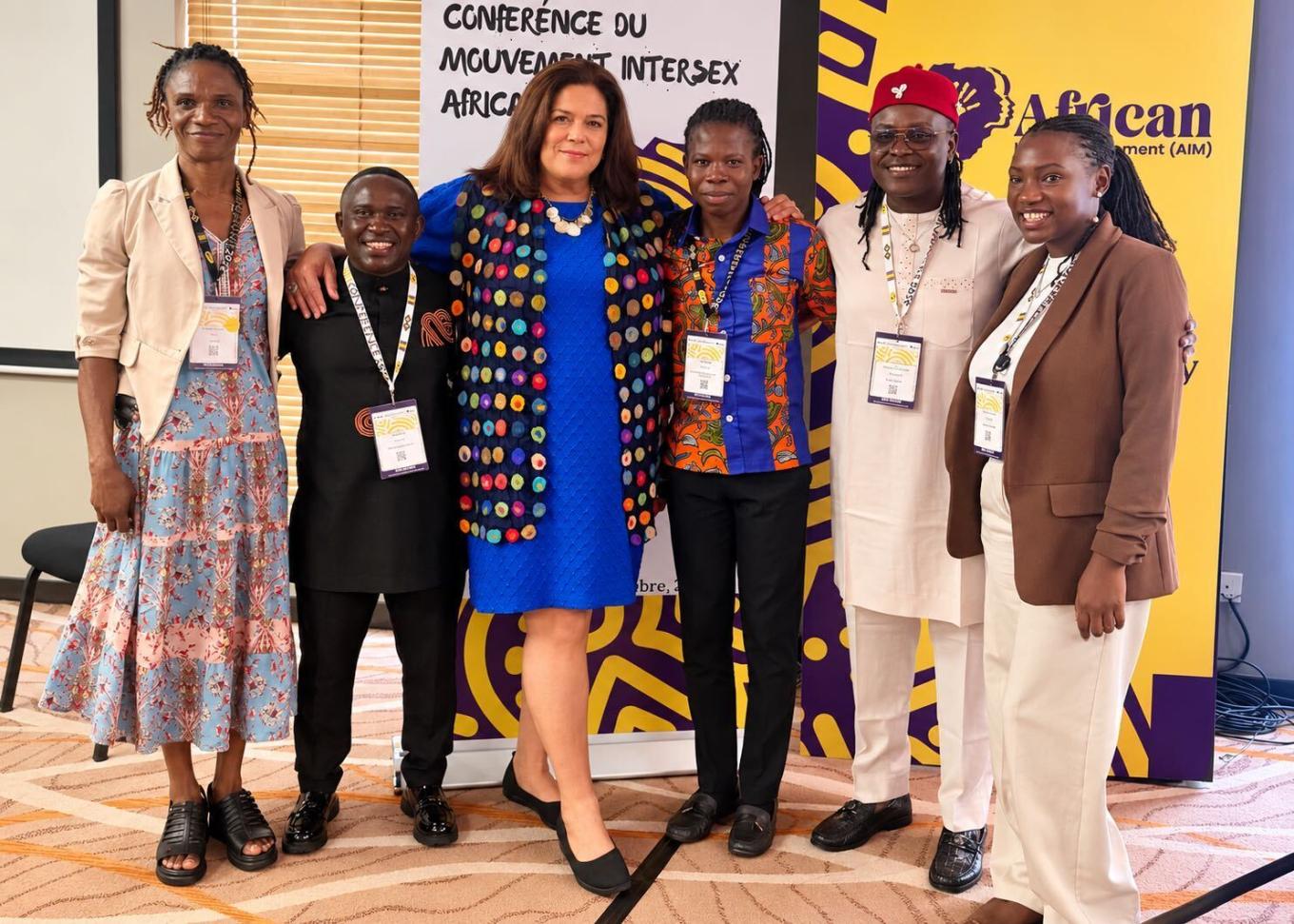
From September 30 to October 2, 2026, more than 150 people, including intersex activists from more than 20 African countries, met in Nairobi, Kenya, for the first-ever African Intersex Movement Conference. The African Intersex Movement (AIM) is a regional network of intersex-led organizations founded in 2017. Intersex people are born with sex characteristics that do not fit typical definitions of male or female bodies. Across Africa, intersex activists have spent years building community and advocating for change in difficult circumstances, and they have led efforts to have intersex people’s human rights recognized. Outright International was a sponsor of the conference.
Below is the full keynote address that Kimberly M. Zieselman (she/her), Outright’s Senior Advisor for Global Intersex Rights, delivered at the conference on October 2, 2026. She then moderated a panel of intersex activists from six global regions on the movement’s challenges, its progress, regional differences, and how to strengthen advocacy together.
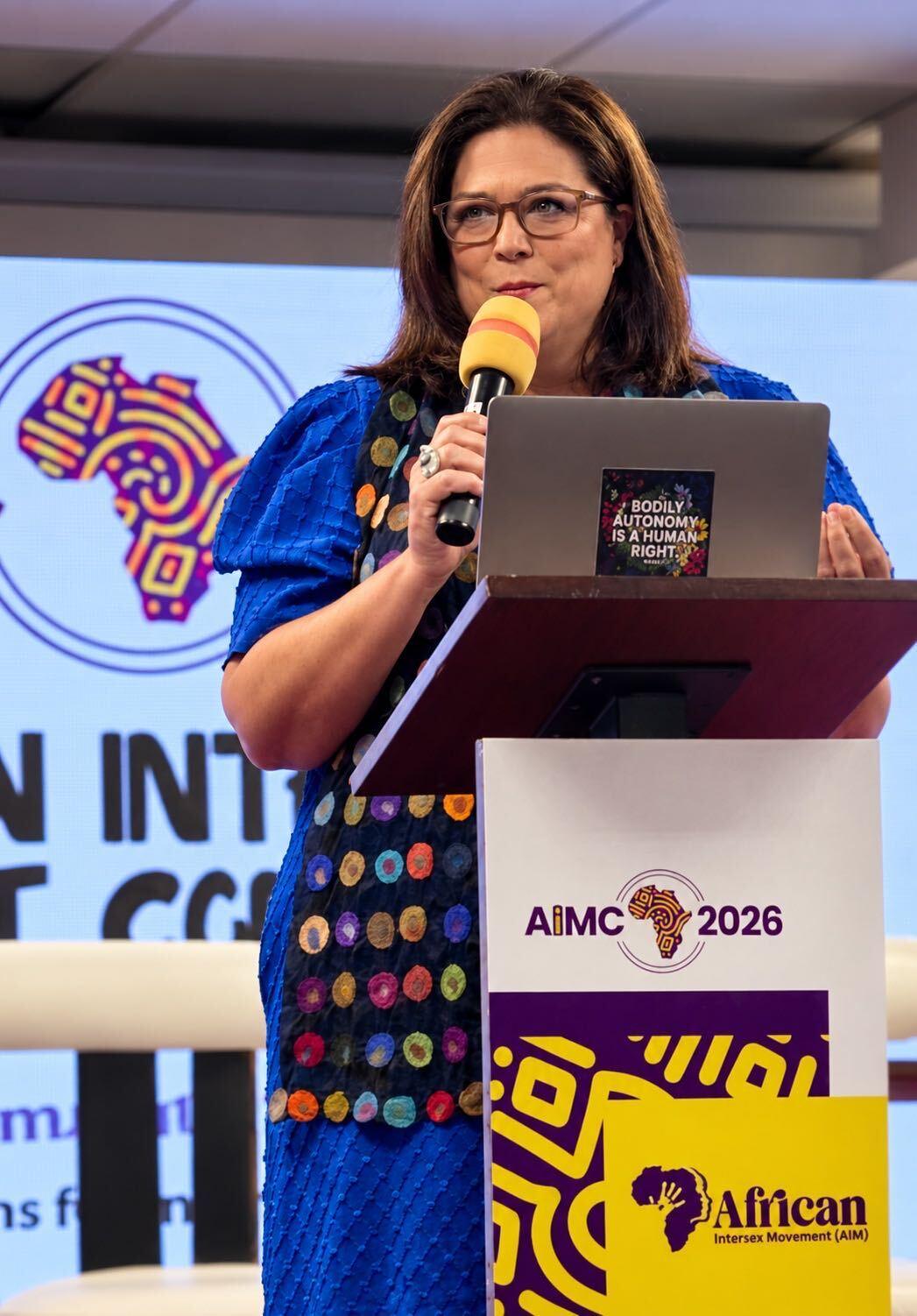
Keynote
Good morning.
I want to begin simply by saying thank you.
Thank you for inviting me into this space to be part of this historic first African Intersex Movement Conference.
I have already learned so much from all of you.
As a leader in the global movement, I found that many of the things said on the first day resonated deeply with me.
A few examples:
- “Leadership is often a lonely place. But we keep at it due to the deep struggles we have endured - and most importantly, for the babies that don't have a voice”
- “The more visible you become, the more isolated you become - you need to be prepared to stand with your inner voice and recognize where you should go and where you should step back.”
- “The movement doesn't need celebrities - it needs more community”
- “Recognition doesn’t come from the outside - it comes from within.”
- “Our success will be measured by the conditions we set up for others to lead”
I did not come to Nairobi to tell the African intersex movement what it needs.
You know what you need.
You know your communities, your political realities, and the strategies that work.
There are experiences here I will never fully understand.
My job in the international roles I have held is not to speak for movements.
It is to help make sure movements can speak — and be heard — for themselves.
I came to this work trying to understand why irreversible decisions had been made about my body as a child before I could consent.
Eventually, that journey became activism, and I became Executive Director of the national organization, interACT.
But leading an intersex organization did not mean I had everything figured out.
I still had a lot to learn myself.
More than 10 years ago, in Geneva in 2015, at one of my first international convenings, I excitedly shared a media article about our young intersex advocates.
Some activists from other countries challenged me because it used the medicalized language “disorders of sex development.”
And, frankly, my first reaction was defensive.
I thought: Here is this amazing article lifting up young intersex voices and raising awareness — why are we arguing about terminology?
The next morning, I sat down over breakfast with one of those activists.
And I listened.
I began to understand that language could reinforce the very idea we were fighting — that there was something “disordered” about our bodies.
At the same time, young intersex advocates at interACT were telling us how they wanted to describe themselves and what they needed from us.
They changed not only my language but also shaped my understanding of leadership.
I realized these young people were not just our future leaders.
They were already leaders.
There is no global intersex movement without strong local intersex movements.
The global movement does not live in Geneva, New York, or Washington.
And it certainly does not live in the offices of international NGOs or foundations.
It lives wherever intersex people find one another.
- When a parent learns their intersex child does not need to be “fixed.”
- When someone discovers there is a word for their experience, and that they are not alone.
It lives in community meetings, people's homes, and rooms like this one.
International organizations, governments, and donors can help create conditions in which those movements have more power.
It is not enough to invite an intersex activist onto a panel or put the “I” into LGBTQI, while activists lack the resources to sustain the work.
If we are serious about movement building, we have to ask:
- Who has the money?
- Who decides where it goes?
- Who gets invited into the room?
- Whose knowledge is considered expertise?
I ask these questions knowing that I work inside some of these systems.
I work for an international policy organization that also raises and redistributes resources to movements - increasingly, including the intersex movement.
And before that, I worked inside the U.S. government.
When I arrived at the U.S. State Department, I discovered how little many people there knew about intersex people. There was a lot of education to do.
I was able to bring five intersex activists from different regions to Washington for a week.
They met with people across the U.S. government — not so I could tell their stories, but so they could tell their own.
Months after I left government, I was with other intersex activists in Geneva as governments debated what became the first UN Human Rights Council resolution on intersex human rights.
Some of what we heard from governments was very painful.
Then the U.S. representative spoke knowledgeably and passionately about the violations intersex people experience and why the United States supported the resolution.
It was a big moment.
I remember sitting there thinking:
This is how change travels.
Those activists had shared their knowledge in Washington. People listened. And eventually, some of that knowledge traveled back to Geneva.
That experience reminded me:
Access matters most when we use it to create access for someone else.
Are we simply funding projects?
Or are we helping to build power?
Building power means investing in people for the long term, letting movements determine their priorities, and recognizing that expertise does not flow in one direction.
The international community has much to offer African intersex movements.
But African intersex movements have just as much to teach the international community - and quite possibly, even more.
The next strategy may come from this room.
The next legal breakthrough may come from this continent.
Our responsibility as a global movement is to make sure those lessons travel — not just North to South, but South to North, and across Africa itself.
Despite extraordinary progress, intersex people everywhere are still fighting many of the same battles.
- Children's bodies are still being changed without their consent.
- Families are still told that an intersex child is something to fear or hide.
- Young people are still bullied out of schools, and adults still struggle to find competent, respectful healthcare.
Too many intersex activists confront enormous violations with tiny budgets and extraordinary personal sacrifice.
We cannot build a sustainable movement that way.
What happens after these three days matters even more.
The relationships you are forming matter.
The person from the smallest organization matters.
The activist for whom it is not yet safe to publicly say “intersex” matters.
A movement is strongest when people do not have to become powerful before they are allowed to belong to it.
I know what this movement gave me.
It gave me other intersex people.
It gave me a history I had never been taught.
It gave me language for things I had been told not to talk about.
It helped turn secrecy and shame … into purpose.
Perhaps that is what this conference represents.
Not the beginning of an African intersex movement.
That movement was already here.
People in this room built it.
People who are not in this room built it.
Some built it without funding or recognition, and at considerable personal risk.
So this conference is not the beginning.
It is a moment of recognition.
A moment to look around this room and say:
We are here.
We found one another.
We have knowledge.
We have power.
And we have work to do together.
For those of us who work internationally, our responsibility is to listen.
To carry your voices into rooms you cannot always access.
To open doors — and then get out of the doorway.
To move resources closer to the people doing the work.
And to make sure intersex people are at the table when decisions about us are made.
- Not as beneficiaries.
- Not as stories.
- Not as evidence.
- But as leaders.
In a few minutes, I will moderate a conversation with intersex activists from several regions.
We do not need one global intersex movement in which everyone speaks with the same voice.
We need a global movement strong enough to hold many voices, histories, cultures, and even disagreement.
Our unity does not require sameness.
It requires solidarity.
So as we leave Nairobi, I hope we ask:
What knowledge can we share?
What resources can we move?
What doors can we open for one another?
And who is not yet in this room — and how do we make sure they are part of what comes next?
The global intersex movement will not be built by any one organization, donor, or country.
And it certainly will not be built by people like me flying in and out of Nairobi.
It will be built by:
- Intersex people finding one another.
- Sharing power.
- Sharing knowledge.
- Making room for new leaders.
- Taking care of one another.
- And refusing to accept a world in which any child is taught that there is something wrong with the body they were born into.
I am grateful to be walking part of that journey with you.
As was said beautifully on the opening day, “Let us all recommit ourselves to the intersex children.”
Thank you.

Take Action
When you support our research, you support a growing global movement and celebrate LGBTIQ lives everywhere.
Donate Now