
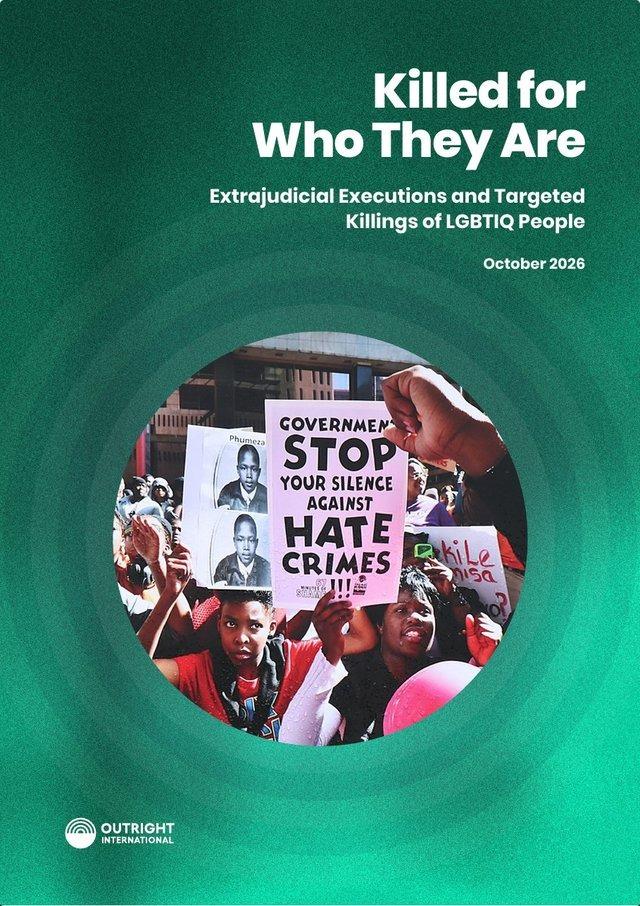
Killed for Who They Are
Extrajudicial Executions and Targeted Killings of LGBTIQ People
In every region of the world, people are murdered because of their sexual orientation, gender identity, gender expression, or sex characteristics. Outright International documented more than 230 of these killings between January 2020 and July 2026, in 17 country case studies and a public annex of names. This report shows how states commit, enable, or ignore them, and what the 2026 UN General Assembly resolution must protect.
Published October 2026 · Outright International · Long read, about 40 minutes · Also available as PDF
The findings in brief
LGBTIQ people are being killed, and states are failing to stop it
A handful of states still write death into law for same-sex conduct. Far more fail LGBTIQ people in quieter ways: they criminalize who they are, refuse to name anti-LGBTIQ killings as hate crimes, and let murders go uninvestigated. The result is a pattern of killings in every region, often preceded by threats and marked by extreme brutality, that the perpetrators expect to get away with.
Trans women and gay men are the most frequent victims in the cases documented, but no part of the community is spared: lesbian, bisexual, and queer women and trans men killed for refusing men, trans and nonbinary teenagers killed by partners hiding a relationship, activists shot after reporting threats to the authorities. In 2026, the UN General Assembly votes again on its biennial resolution against extrajudicial, summary, or arbitrary executions. This page sets out the evidence for keeping sexual orientation and gender identity in it, region by region, with the full annex of documented killings. The complete report, with endnotes and sources, is in the PDF.
Key findings
Five findings
Killings were documented across regions and across the spectrum of queer identities. The report does not claim to count every case: it shows the scale, the patterns, and the state failures behind them.
How we know
The evidence base
Few states keep any record of whether a murder victim was LGBTIQ. This report fills part of that gap by compiling cases from many sources and checking them against each other.
230+
targeted killings in the annex, January 2020 to July 2026
17
country case studies across six regions
6.5
years of public reporting reviewed
230+ killings are included where authorities, civil society, or families have reason to believe the victim was killed because of their actual or perceived sexual orientation, gender identity, gender expression, or sex characteristics (SOGIESC).
17 case studies were chosen where Outright could obtain and verify data through several sources. A country's absence does not mean an absence of killings.
6.5 years of reporting were reviewed, from international bodies, credible media in many languages, journalists, and civil society observatories, cross-referenced for accuracy.
Two in three UN member states do not recognize hate crimes based on sexual orientation
UN member states that legally recognize hate crimes on each ground, out of 193.
63
Sexual orientation
33% of UN member states
40
Gender identity
21% of UN member states
9
Sex characteristics or intersex status
4% of UN member states
193
All UN member states
Source: ILGA World, cited in the report (endnote 34).
More documented cases do not mean more killings
Brazil, South Africa, and the United States account for many of the cases here because police, civil society, and media there report them, not necessarily because killings are more frequent. Where criminalization, stigma, conflict, or crisis suppress reporting, as in parts of Southwest Asia and North Africa, far fewer cases surface. Read every country figure on this page as a floor.
The UN resolution
How sexual orientation and gender identity entered the resolution, and who has tried to remove them
Every two years, the UN General Assembly condemns extrajudicial, summary, or arbitrary executions and names the groups most at risk. LGBTIQ people have been on that list for more than two decades, and the language has been challenged at every vote since 2010.
Quote from Rwanda
“Whether or not we support the claims of people with a different sexual orientation, whether or not we approve of their sexual practices—but we must deal with the urgency of these matters and recognize that these people continue to be the target of murder in many of our societies, and they are more at risk than many of the other groups listed.”
The 2026 vote
“Sexual orientation and gender identity” must stay in the 2026 resolution
Removing one of the populations most exposed to targeted killing from a resolution that holds states accountable for preventing them amounts to denying LGBTIQ people the right to life. The report also urges states to apply a full gender lens: every anti-LGBTIQ killing is gender-based violence.
Part I
Condemned by law
The most flagrant form of arbitrary execution is one carried out by the state. Under international law, a death sentence for consensual same-sex conduct is arbitrary even if the trial was otherwise fair.
Executions specifically for consensual same-sex acts are rare, and most of these provisions are seldom or never formally applied. But a death penalty on the books, explicit or implied, is itself a violation of the right to life. It heightens the risk of extrajudicial killing, vigilante violence, and the coercive threat of prosecution, however often it is used.
- Afghanistan: the penal code provides for death for anyone "who repeatedly commits homosexual acts."
- Mauritania: Article 308 prescribes death by stoning for any adult Muslim man for same-sex conduct.
- Iran: Article 234 of the Islamic Penal Code applies the death penalty to the receptive partner in anal sex between men.
- Brunei, Saudi Arabia, and Yemen: death if married; lashing and imprisonment otherwise.
- Northern Nigeria: twelve Shariah states each have their own penal code; in some, death applies generally.
- Uganda: the 2023 Anti-Homosexuality Act makes "aggravated homosexuality," including repeated consensual sex, a capital offense.
Quote from UN Special Rapporteur
“Government failure to actively intervene to protect the rights of LGBT, gender-diverse, and intersex persons…leads to their deaths.”
Most states neither execute people for same-sex relations nor protect them from being killed. Under the Universal Declaration of Human Rights and the International Covenant on Civil and Political Rights, they are required to prevent and prosecute these killings. The persistent murder of LGBTIQ people is a failure to meet that duty.
Part II
Killings by region
Each region's laws, conflicts, and politics shape how LGBTIQ people are killed and whether anyone answers for it. The case studies that follow are drawn from countries where Outright could verify data through several sources.
Where civil society tracks the cases, most killings go unpunished
Impunity measures reported by national LGBTIQ organizations in two countries with protective laws on the books.
97%
Honduras: impunity rate, killings of LGBTIQ people, 2023 to May 2026
70%
Mexico: 2024 killings with no prosecution, as of September 2025
Sources: Red Lésbica Cattrachas; Sin Violencia LGBTIQ+ Network, as cited in the report. Each measure uses its organization's own case base and is not comparable across rows.
100 killings in the annex
The Americas
Many countries in the region have advanced legal protections for LGBTIQ people, including aggravated penalties for homicides motivated by sexual orientation or gender identity. But prosecutions under those provisions are rare. Patriarchal norms, gun violence, organized crime, and hostile political rhetoric keep LGBTIQ people in danger.
5
Caribbean states are the only ones in the hemisphere that still criminalize same-sex conduct
22
UN member states in the region recognize hate crimes based on sexual orientation
14
do so based on gender identity
Country case studies. Open each country to read the case study.
Brazil recognizes bias based on sexual orientation or gender identity as an aggravating circumstance, yet killings are often marked by the brutality criminal groups use to spread terror. Between December 2023 and May 2025, reported murders included at least two decapitations and at least three cases in which the victim's heart was removed.
Brazil is also home to the youngest victim documented in this report: in 2024, a 12-year-old gay boy died in hospital after his stepfather beat him as "punishment." The stepfather was sentenced to 25 years; the final sentence does not mention homophobia.
- 204 queerphobic homicides documented by Grupo Gay da Bahia in 2025
- 61% of those victims were gay men
- 25% were trans women
Colombia has no public system to record violent deaths of LGBTIQ people, so civil society does the counting. In February 2024, armed men killed Aldinebin Ramos, a nonbinary peace activist, in their home in Tolima. Ramos was the third member of Chaparral Diversa to die after submitting a case to the Special Jurisdiction for Peace. An armed group then circulated a list declaring queer people and their relatives "military targets."
Indigenous leader and volunteer firefighter Fernanda Domicó, a trans woman, was stabbed and thrown in a river in July 2025. Cristina Ramírez, a trans and intersex woman, was shot four times in her home in January 2024; activists know of no arrests.
Violence against queer people operates as "mechanisms of bodily control and punishment against non-normative sexual identities and orientations."
Caribe Afirmativo
- 440 homicides and femicides registered by Colombia Diversa, January 2020 to May 2026
- 270 violent murders registered by Caribe Afirmativo in 2025
Guatemala does not criminalize anti-LGBTIQ hate crimes or prohibit discrimination. In April 2024, police in Chimaltenango arrested a gay couple, Eldin Choc and Milton Santamaría. Prosecutors charge that officers tortured both men to death in a police station while making homophobic statements, then dumped their bodies in a ravine.
In June 2021, two members of the trans women's organization OTRANS Reinas de la Noche were killed within three days: Cecy Caricia Ixpata, whose killing is unsolved, and executive director Andrea González. Both had reported transphobic threats to the Attorney General's Office.
- 39 killings recorded by Sin Violencia LGBTIQ+ in 2023
- 36 recorded in 2024
The penal code treats hatred based on sexual orientation or gender identity as an aggravating circumstance in murder, but enforcement is weak. Killings of a gay couple in their store in 2022, of trans activist Melissa Núñez the same year, and of two trans sex workers in November 2023 all remain unsolved.
The Inter-American Court of Human Rights has ruled against Honduras twice: in 2021 for the 2009 murder of Vicky Hernández, and in January 2026 for failing to investigate the 2004 killing of Leonela Zelaya. The legal protections the Court ordered remain unimplemented.
- 48 violent killings in 2024, Asociación Kukulcán
- 45 in 2025
- 24 in 2026, as of July
- 97% impunity rate, 2023 to May 2026
"The abominable crime of buggery" and "gross indecency" remain criminalized despite a 2021 Inter-American Commission decision directing their repeal. A police official has warned of perpetrators using dating apps to lure queer men and attack them. In 2020, Allie Jackson went on a date during his lunch break and was killed; he was buried in a shallow grave.
- 54% of 962 LGBT Jamaicans surveyed in 2022 knew someone killed for their sexual orientation or gender expression in the previous 12 months
Mexico leads the region on formal equality, but organized crime and gender-based violence make it deadly. Ociel Baena, the country's first nonbinary magistrate, was murdered at home with their partner in November 2023 after receiving death threats; the state called it a "crime of passion." Trans Senate candidate Samantha Fonseca was shot dead in January 2024, the day after speaking out against violence toward trans women. In June 2026, LGBTIQ and Afro-Mexican rights defender Sael Silva Cisneros was shot dead in Guerrero.
The state does not disaggregate its registry of more than 128,000 missing persons, so disappeared LGBTIQ people go uncounted. There is one sign of progress: in June 2026, a Mexico City court issued the country's first conviction under the new offense of transfemicide, for the attempted murder of journalist Natalia Lane.
I'm afraid no one will look for my daughter because she's trans.
Mother of Lilith Saori Arreola Alvear, missing since January 2023
- 71 active cases of missing LGBTIQ people identified by civil society in 2025
- 70% of 2024 killings with no prosecution as of September 2025
A January 2025 executive order ended federal antidiscrimination protections for trans and intersex people. The Justice Department's Civil Rights Division was directed to halt new civil rights cases, and gender identity questions are being removed from national crime data. Reports of hate crimes, particularly against trans people, have risen.
Anti-LGBTIQ violence intersects with gun violence: the 2022 Club Q shooting in Colorado killed five people; in 2023 a 17-year-old opened fire on a queer punk event in Minnesota, killing musician August Golden. In 2025 in Texas, a neighbor shot Jonathan Joss dead after hurling homophobic slurs at him and his husband outside their burned home.
- 616 anti-LGBTIQ state bills introduced in 2025; 76 enacted (ACLU)
- 529 tracked in 2026 as of August; 40 enacted
- 5 people killed at Club Q, Colorado, 2022
54 killings in the annex
Sub-Saharan Africa
The colonial legacy of criminalization endures. It contributes to stigma, violence, and impunity, and keeps victims from reporting crimes without risking arrest themselves. South Africa is the only country in the region that recognizes hate crimes based on gender expression and sex characteristics, and also among the places where the most killings are documented.
25 of 48
countries criminalize consensual same-sex conduct
2
punish it with death: northern Nigeria and Uganda
36
killings in South Africa since 2020 are in the annex, three of them children
South Africa protects sexual orientation in its constitution and created hate crime offenses in 2024, in a country that declared gender-based violence a national emergency in 2025. On February 15, 2025, Imam Muhsin Hendricks, an openly gay advocate for LGBTIQ inclusion in faith spaces, was ambushed and shot dead after receiving death threats. No one has been arrested.
The authorities' silence and inaction "reinforces the dangerous idea that it is acceptable to kill queer Muslims."
Members of the Al-Ghurbaah Foundation
- 14+ queer people murdered in suspected hate crimes since 2024
- 36 targeted killings since 2020 compiled in the annex
Same-sex conduct has been criminalized since British rule, and violence against LGBTIQ people is typically investigated only under "enormous pressure and outcry." Convictions in the killings of nonbinary lesbian Sheila Lumumba (2022) and activist Edwin Chiloba (2023) came after families and defenders pushed; in Lumumba's case, they found the weapons and CCTV footage police had missed. No one has been convicted for the 2021 torture and murder of Joash Mosoti or the 2022 murder of Rose Mbesa, an intersex woman.
The High Court struck down a ban on same-sex sexual conduct in 2024, but a string of murders followed hateful rhetoric in parliament. Sexy Frederik, a trans woman, was stabbed 61 times in May 2024.
For those two days in parliament, there was a rampant dehumanization of LGBTQ people. Words like Satanists and Demonic were used.
Friedel Dausab, Positive Vibes
Federal law punishes same-sex acts with up to 14 years in prison, and 12 of 36 states apply Shariah codes that allow death by stoning. Gangs exploit that vulnerability. In October 2025, 23-year-old Hilary Ikechukwu Emereole was lured, beaten, extorted, and thrown from a window; police asked for money to "mobilize" the investigation. In July 2025, classmates in Kano beat two secondary school students to death after accusing them of being gay.
7 killings in the annex
Southwest Asia and North Africa
Most countries in the region criminalize same-sex acts, and no country recognizes anti-LGBTIQ hate crimes. Judges continue to reduce sentences for so-called honor killings, even where the legal basis has been repealed. Conflict and occupation add further danger, and reporting is suppressed, so the cases documented here are the smallest share of any region.
0
countries recognize hate crimes based on SOGIESC
41+
people accused of "sodomy" executed by ISIS in Syria and Iraq, 2014 to 2016
23
people sentenced to death by the Houthis in Yemen in early 2024, 13 by stoning or crucifixion
In 2024, Iraq's parliament passed a bill punishing same-sex relations with up to 15 years in prison. Armed groups, some linked to the government, persecute sexual and gender minorities. Families also kill: in January 2021, 23-year-old trans woman Doski Azad was killed by her brother in Kurdistan.
They sent me a picture of Moqtada al-Sadr and said, "We have been cleaning the city from people like you for years."… A couple of months later, he was killed.
Laith (pseudonym), on his boyfriend's killing in May 2020, in testimony published by Human Rights Watch
In Iran, 17-year-old Parsa was killed by their father in January 2024 over makeup, dyed hair, and gender nonconforming behavior, after forced "conversion" attempts. The father served six months.
44 killings in the annex
Europe and Central Asia
Protections vary sharply. Only Turkmenistan and Uzbekistan still criminalize same-sex acts, but countries considered safer are seeing setbacks, and policy hostility toward trans people may fuel violence. In 2023, 16-year-old Brianna Ghey was lured to a park and stabbed to death by two teenagers in the U.K.; the judge treated transphobia as an aggravating factor.
Hate crime law in the region covers sexual orientation far more often than any other ground
UN member states in Europe and Central Asia that prohibit hate crimes on each ground. Source: ILGA World, cited in the report (endnote 242).
32
Sexual orientation
23
Gender identity
8
Sex characteristics
6
Gender expression
Russia has banned "displaying non-heterosexual orientation" and declared queer organizing "extremist." In 2017, Chechen security officials detained, starved, and tortured men suspected of being gay, then outed them to their families to encourage honor killings. Officials have publicly defended the practice.
In November 2025, Aliya Ozdamirova, a queer woman who had fled to Georgia, was forcibly returned to Chechnya by a relative and reportedly died the same day. Her family said it was natural causes; North Caucasus SOS believes it was an honor killing.
Every minute I risk my life—either they will kill me here, or they will cut me up.
Aliya Ozdamirova, in a recorded conversation with North Caucasus SOS
In Spain, Samuel Luiz was beaten to death in the street in 2021 after homophobic slurs; four men were convicted in 2025. Around 40% of LGBTIQ victims of violence in Spain do not report it, many because they believe it "won't do any good."
22 killings in the annex
Asia
Nine countries criminalize consensual same-sex acts. Apart from Mongolia, the region has no hate crime laws covering sexual and gender minorities. In a 2025 survey of trans and gender-diverse people in India, Malaysia, Nepal, and Sri Lanka, one in three trans women had been physically assaulted, and two in five had experienced sexual violence.
Since August 2021, "habitual" same-sex conduct is punishable by death, and the morality police enforces "moral crimes." Outright documented the case of Ghulam, a counselor to LGBTIQ people, found dead with signs of beating and sexual assault in January 2022. In August 2022, the Taliban abducted 22-year-old Hamed Sabouri, tortured and killed him, and sent his family a video of the execution. Some families report relatives to the Taliban to protect themselves.
In July 2025, the International Criminal Court issued arrest warrants for Taliban officials for gender persecution, including against people perceived as not conforming to the Taliban's expectations of gender identity or expression.
Same-sex relations were decriminalized in 2018, but India has no hate crime statute covering sexual orientation. Families carry out so-called honor killings: in 2021, Reshpal Kumar, a gay man, was stabbed to death by his son, and trans teenager Dakshayani was murdered by her brother.
Despite long cultural recognition of trans people, trans women are frequent victims. Five were killed within a month in 2022; three were shot at close range and left by a roadside in September 2025. Honor killings are often recorded as suicide or natural death. In 2020, Saeeda Khan was shot by her 13-year-old sibling after dancing at an event, and police continued to misgender her after her death.
6 killings in the annex
Oceania
Six countries criminalize same-sex activity under colonial-era laws, while Australia and Fiji have some of the strongest legal protections anywhere. Violence persists: in February 2026, a trans woman known as Joëlla was kicked to death in New Caledonia, a territory of France.
88
suspicious deaths in Sydney, 1970 to 2010, possibly linked to anti-LGBTIQ bias; about 30 unsolved
1 in 5
trans and nonbinary people in New Zealand have been threatened with violence
7 in 10
women in Fiji report physical or sexual abuse since age 15, and trans women may experience even higher rates of violence
Fiji bans discrimination based on sexual orientation and gender identity in its constitution, but has one of the highest rates of gender-based violence in the world. A suspect in the 2018 killing of trans woman Lucky Salavuki was acquitted because of gaps in the police investigation. In 2024, police attributed the death of trans sex worker Esther Ravato to medical complications; witnesses told a rights group she was tortured and killed.
Part III
Patterns that cross borders
Some patterns of violence appear in every region. The UN Human Rights Committee requires states to respond "appropriately to patterns of violence against categories of victims." These four demand specific measures.
Every anti-LGBTIQ killing is gender-based violence
Queer men are killed for not being "man enough." Queer women are killed for decentering men in their intimate lives. Trans, nonbinary, and intersex people are killed because their existence upends the rigid gender system that patriarchy depends on. Yet governments, and at times the UN, often treat gender-based violence as violence against cisgender, heterosexual women only.
In May 2024 in Buenos Aires, a man threw a Molotov cocktail into the home of four lesbian neighbors he had called "monsters," and pushed them back into the fire. Three died. They had already filed harassment complaints; nothing was done. Trans people are frequently killed by partners: in Spain in May 2026, Kimberli, a Honduran trans woman, was stabbed by her former partner two hours after his release from custody, days after police assessed her as not at serious risk.
7 in 10
trans and gender nonconforming people killed in the U.S. in 2020 were killed by someone they knew (Human Rights Campaign)
2
killings of intersex people are documented in the report, a finding about intersex invisibility, not rates of violence. "Sex characteristics" appears in no UN resolution on extrajudicial killings
Killed in flight, killed on arrival
LGBTIQ people who flee danger often find receiving states unable or unwilling to protect them. Chriton "Trinidad" Atuhwera, a 22-year-old Ugandan, died when part of Kakuma Refugee Camp in Kenya was fire-bombed in 2021. In 2024, Turkish officials shared the identity and HIV status of a trans asylum seeker from Syria on social media; she was refused asylum, returned to Syria, and reportedly killed. Migrant trans sex workers were killed in France, Greece, Italy, Russia, and Estonia.
Lured through dating apps
Criminal groups use stigma and criminalization to trap gay men through dating apps for extortion, robbery, and murder, resulting in at least one "kito" murder in Nigeria in 2025 and four killings in Brazil in 2024. In India, a 52-year-old diamond worker was beaten to death by three people aged 14 to 18 who lured him online and threatened to out him. Alleged serial killers have used gay dating apps to identify victims in Canada, Ireland, Spain, and the U.S.
Terrorism and extremism
In May 2021, Shining Path killed at least 18 people at a bar in Peru and left pamphlets announcing a "social cleansing" of "degenerate homosexuals." Mass shootings at queer bars followed in Norway and Slovakia in 2022. In July 2026, an Islamic State sympathizer drove a van into a crowd near the Christopher Street Day Pride parade in Berlin, Germany, killing one person and injuring 29.
Quote from UN Special Rapporteur
“Without State protection, LGBTIQ+ refugees may be subjected to violence.”
The annex
Targeted killings, January 2020 to July 2026
The report's annex lists more than 230 lesbian, gay, bisexual, transgender, intersex, and queer people killed because of who they were. It is not exhaustive. It is a record of people whose deaths someone was able to document.
Before you read the entries
Entries describe killings in detail, including torture, sexual violence, and mutilation. Each is summarized from a public source, linked at the end of the entry. Names and identities are given as reported; some victims were misgendered or deadnamed in the original coverage, and Outright has used the names and genders they lived by wherever known.
Who is in the annex
The 233 entries are classified here by the identity reported for each victim and by region. These reflect where killings are reported and verified, not where they happen most.
Identity groups are Outright's grouping of the identity recorded in each entry. "Other or undisclosed" includes victims whose identity was not reported and people killed alongside LGBTIQ victims. The full annex, with every entry and its source, is in the PDF.
Recommendations
What states, the UN, and the media must do
States are obligated under international human rights law and existing UN resolutions to prevent these killings, investigate them, and give victims' families justice. The report sets out 31 recommendations.
Key recommendations for member states
- Decriminalize consensual same-sex acts and repeal laws that criminalize or stigmatize people based on sexual orientation, gender identity, gender expression, or sex characteristics.
- Recognize bias-motivated killings of LGBTIQ people as hate crimes, and investigate and prosecute them.
- Ensure remedies, justice, compensation, and support for survivors, families, and communities.
- Collect and publish disaggregated data on violence against LGBTIQ people, safely, and use it with civil society to prevent violence.
- Reform policing, including through mandatory training on crimes against sexual and gender minorities.
- Create independent oversight with real power to discipline police who commit or willfully fail to investigate violence.
All 31 recommendations
- Decriminalize consensual same-sex sexual activity and repeal laws that criminalize, stigmatize, or discriminate based on sexual orientation, gender identity, gender expression, or sex characteristics.
- Enact and enforce hate crime laws covering killings motivated by actual or perceived sexual orientation, gender identity, gender expression, or sex characteristics, and ensure such killings are effectively investigated and prosecuted.
- Ensure effective remedies and resources, including access to justice, compensation, and assistance for survivors, victims' families, and affected communities.
- Collect and publish disaggregated data on killings and violence against LGBTIQ people, while protecting privacy.
- Use that data to design prevention and social acceptance measures, in consultation with LGBTIQ civil society.
- Uphold the 1951 Refugee Convention and its 1967 Protocol, protect LGBTIQ refugees, migrants, and asylum seekers, and respect non-refoulement.
- Resource LGBTIQ civil society and work with it so that laws, policies, and programs on violence include sexual and gender minorities.
- Reform policing as a driver of violence, through training and competence in handling cases involving LGBTIQ people.
- Establish independent police oversight with real investigative and disciplinary authority.
- Train public institutions to address institutionalized discrimination and treat everyone with dignity.
- Publicly call for an end to all violence based on sex, gender, sexual orientation, gender identity, gender expression, or sex characteristics.
- Keep sexual orientation and gender identity explicitly protected in UN resolutions on extrajudicial, summary, or arbitrary executions.
- Revise and enforce gun laws to prevent deadly violence, including bias-motivated killings.
- Investigate enforced disappearances, with frameworks for aggravating circumstances based on sexual orientation, gender identity, gender expression, or sex characteristics.
- Decriminalize sex work and grant sex workers rights, including protection from violence and discrimination.
- Regulate dating-app companies to detect fake profiles and entrapment networks, provide clear reporting channels, and work with civil society on safeguards.
- Establish standardized, disaggregated data collection on LGBTIQ homicides and disappearances.
- Use the data to design programs that prevent violence and promote acceptance, with LGBTIQ civil society.
- Fund specialized investigative and prosecutorial capacity for crimes against sexual and gender minorities, not only legislative reform.
- Integrate LGBTIQ protection into organized crime, transitional justice, humanitarian, and displacement programming, rather than exclusively as a separate track.
- Support decriminalization of consensual same-sex acts and sex work as violence prevention.
- Resource community-based LGBTIQ organizations directly, with streamlined access to UN funding.
- Mandate inclusive reporting on sexual orientation, gender identity, gender expression, and sex characteristics (SOGIESC) within existing UN human rights mechanisms.
- Use victims' correct names, gender, and pronouns, including where these differ from legal documents.
- Protect the dignity of victims and survivors. Share images of bodies or violence only with care and safeguards.
- Do not excuse, minimize, or romanticize the perpetrator's actions, or shift blame onto the victim's identity, behavior, or relationships, including in intimate partner violence.
- Report factually and focus on the responsibility of perpetrators and state authorities, not victims, families, or communities.
- Establish or strengthen monitoring of bias-motivated killings: date, place, the authorities' response, and the evidence of anti-LGBTIQ motive, while safeguarding sensitive information.
- Share documentation practices and lessons across regions and organizations, excluding personally identifiable data.
- Design public campaigns and programs to reduce anti-LGBTIQ violence and foster inclusion.
- Build community-based initiatives on intimate partner violence in diverse relationships, recognizing the distinct barriers survivors face.
Methodology
How the cases were compiled
The report compiles killings where state authorities, civil society organizations, or victims' families have reason to believe the person was killed because of their actual or perceived sexual orientation, gender identity, gender expression, or sex characteristics. It focuses on January 2020 to July 2026 and builds on Outright's 2024 submission to the UN Special Rapporteur on extrajudicial, summary, or arbitrary executions.
Cases come from publicly available reports by international bodies, credible media in many languages, journalists, and civil society organizations, and were cross-referenced across sources. Media reports may contain errors about a victim's name, age, gender identity, or sexual orientation; Outright has corrected these where possible, but some details may not be exact.
Questions and answers
Questions and answers
It is the deliberate killing of a person outside any legal framework, and a violation of the right to life. Killings of LGBTIQ people committed by the state, or by others with state complicity or support, are extrajudicial executions. Killings by mobs, vigilantes, and individuals engage the state's duty to prevent, investigate, prosecute, and provide remedy.
- Extrajudicial: killings outside the judicial or legal process that are illegal under national and international law.
- Summary: a death sentence imposed through a procedure that curtails or ignores due process guarantees.
- Arbitrary: killing by order of a government, or with its complicity, tolerance, or acquiescence, without any judicial process.
No. The report focuses on cases in which Outright was able to obtain strong evidence that a particular killing was motivated by bias toward the victim's sexual orientation, gender identity, gender expression, or sex characteristics. Few states record whether a murder victim was LGBTIQ, and only a third recognize anti-LGBTIQ hate crimes at all. The 230+ cases are those that Outright could verify from public sources. They begin to show the scale of the problem, not its full extent.
Because killings there are more often reported by police, civil society, and media. Better reporting is not always evidence of more killings. Countries where criminalization, stigma, or conflict suppress reporting are likely underrepresented.
The figure reflects how invisible intersex people remain in law, policy, and data, not a low rate of violence. Outright has received multiple anecdotal reports of killings of intersex infants, but could not document specific cases. "Sex characteristics" is not included in any UN resolution on extrajudicial killings.
The General Assembly votes on its biennial resolution on extrajudicial, summary, or arbitrary executions. Sexual orientation has been named in it since 2002, and gender identity since 2012. States have tried to remove both terms at every vote since 2010. Outright is calling on member states to keep them.
Yes, with attribution to Outright International. Please use the citation below, link to this page, and use victims' names and genders as the report gives them. For permissions, interviews, or image use, contact [email protected].
For journalists and researchers
Report on these killings with care
The report asks the media to do four things: use victims' correct names and pronouns, protect their dignity, avoid framing killings in ways that blame the victim, and keep the focus on accountability for the perpetrators and the state.
Acknowledgments
This report was researched and written by Natalia Marsicovetere, an external consultant, with additional research, writing, and review by Ohotuowo Ogbeche, Global Researcher at Outright International, and Neela Ghoshal, Senior Director for Law, Policy and Research. Neela Ghoshal and Maria Sjödin, Executive Director, reviewed and edited it. Venus Aves, Research and Program Associate, edited and proofread it, and Lui Iarocheski, Director of Marketing and Communications, designed it.
Outright is deeply grateful to the LGBTIQ activists and organizations who shared their databases, observatories, and reports. We will continue to work in solidarity with human rights movements for better LGBTIQ lives everywhere.
Cover photo: Photograph posted outside the office of Iranti, a media advocacy organization, in Johannesburg, South Africa. Photo: Jordyn Bradley/Medill.