

Press Release
UN Committee Refuses to Erase LGBTQ Victims From Resolution on Unlawful Killings
Region(s)
Publish Date
November 13, 2026
Authors
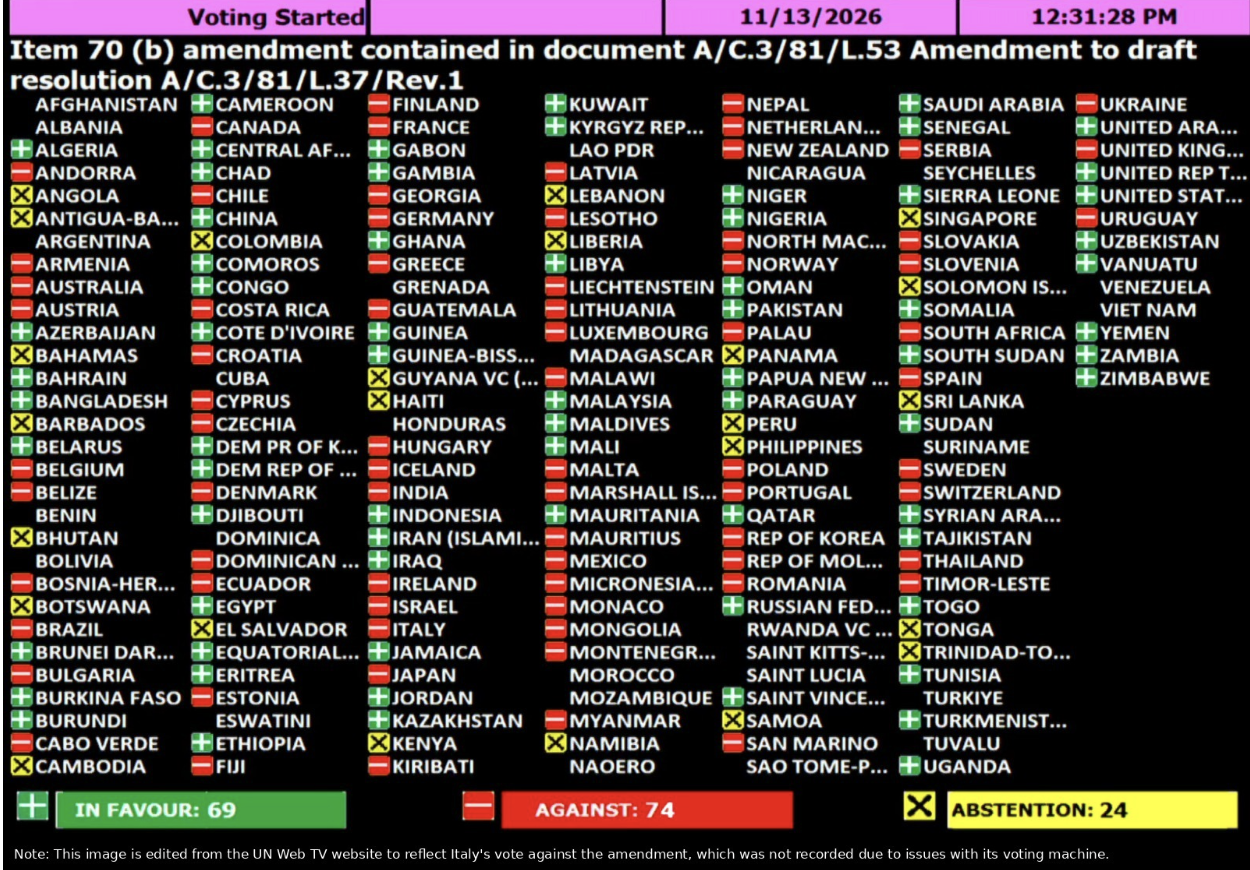
UN Committee rejects Egypt-led amendment 74 to 69; Outright warns the shrinking margin shows the right to life of LGBTQ people has become increasingly contested at the UN.
Key facts:
- Amendment defeated 74 to 69, with 24 abstentions and 26 not voting
- United States: voted “yes” to delete LGBTQ persons
- Resolution adopted 131 in favor, 0 against, 47 abstentions, and 15 not voting
NEW YORK, November 13, 2026 — The UN General Assembly’s Third Committee, which handles human rights issues, voted today to retain explicit references to sexual orientation and gender identity in a resolution on extrajudicial, summary or arbitrary executions. An amendment to remove those references was narrowly defeated, with 74 votes against, 69 in favor, and 24 abstentions. Egypt introduced the amendment on behalf of most members of the Organisation of Islamic Cooperation. The United States voted in favor of the amendment, marking the first time in the voting record dating back to 2002 that it has backed removing this language from the resolution. The committee then adopted the draft resolution with the reference intact. A similar amendment could be introduced when the full General Assembly takes up the resolution in December.
The resolution is based on a simple premise: No one should be subjected to targeted killings because of who they are, and when killings take place, states have an obligation to investigate, prosecute, and provide justice to the families left behind. The amendment would have taken off the list of victims that states should look out for those people killed because of their sexual orientation or gender identity. As Outright’s research shows, in every part of the world, lesbian, gay, bisexual, trans, intersex, and queer (LGBTIQ) people are killed for who they are, and few states take sufficient measures to prevent and respond to these killings.
The margin was much narrower than in 2024, when a similar amendment failed 78 to 47. The resolution as a whole was then adopted with 131 votes in favor and 47 abstentions. It now goes to the General Assembly Plenary in December.
Quote from Maria Sjödin (they/she)
Today, the UN’s Third Committee narrowly rejected an attempt to remove explicit recognition of people killed because of their sexual orientation or gender identity. Outright documented more than 230 targeted killings of LGBTIQ people across every region. When the full General Assembly votes in December, governments must keep that language intact and make clear that the right to life belongs to everyone.
A resolution that names who is being killed
The resolution, presented every two years by the Nordic countries, asks states to investigate unlawful killings and hold perpetrators to account. It names groups at heightened risk, including journalists, human rights defenders, Indigenous Peoples, religious minorities and victims of so-called honor killings. Sexual orientation has been on that list since 2002, and gender identity since 2012. States opposed to the language have tried to remove it again and again since it was first included.
A resolution on unlawful killings should follow the evidence on who is being targeted and killed. On LGBTIQ victims, that evidence is clear. This year’s vote came weeks after Outright published Killed for Who They Are: Extrajudicial Executions and Targeted Killings of LGBTIQ People, which documents more than 230 targeted killings of LGBTIQ people in every region between January 2020 and July 2026 – a number that is likely only a fraction of the many undocumented and uninvestigated killings that take place. The victims were aged 12 to 77; 18 were children, some killed in extraordinarily brutal ways. Yet, sixty-five UN member states still criminalize consensual same-sex conduct, and eight prescribe the death penalty, directly contributing to fatal violence. Only 63 of 193 recognize hate crimes based on sexual orientation, and 40 based on gender identity, so the motive behind many more killings never appears in the case file.
Quote from Ohotuowo Ogbeche (she/her)
Replacing ‘sexual orientation or gender identity’ with ‘any other considerations’ makes these victims invisible. Behind every case in our report is a grieving family and community, often still waiting for an investigation or justice. This resolution is a source of hope for them: that they can legitimately look to their governments to help give them answers.
How states voted
The vote took place amid a sharp shift in the politics of the General Assembly. Last December, a similar Egypt-led amendment cut language on sexual orientation and gender identity from the UN’s disability rights resolution by four votes, 81 to 77, after intense joint lobbying by Egypt and the United States. This resolution now similarly goes to the full General Assembly in December. Outright calls on all Member States to stand by today’s outcome.
Caption: Voting chart for the vote on the amendment.
United States: Today, the United States voted to remove the references to sexual orientation and gender identity in the resolution. This was in marked contrast to its steady position since 2002, when sexual orientation was first introduced in the resolution. In 2010, it was actually the United States that led the effort at the General Assembly to restore “sexual orientation” after it was stripped in the Third Committee. Today, it voted to remove it.
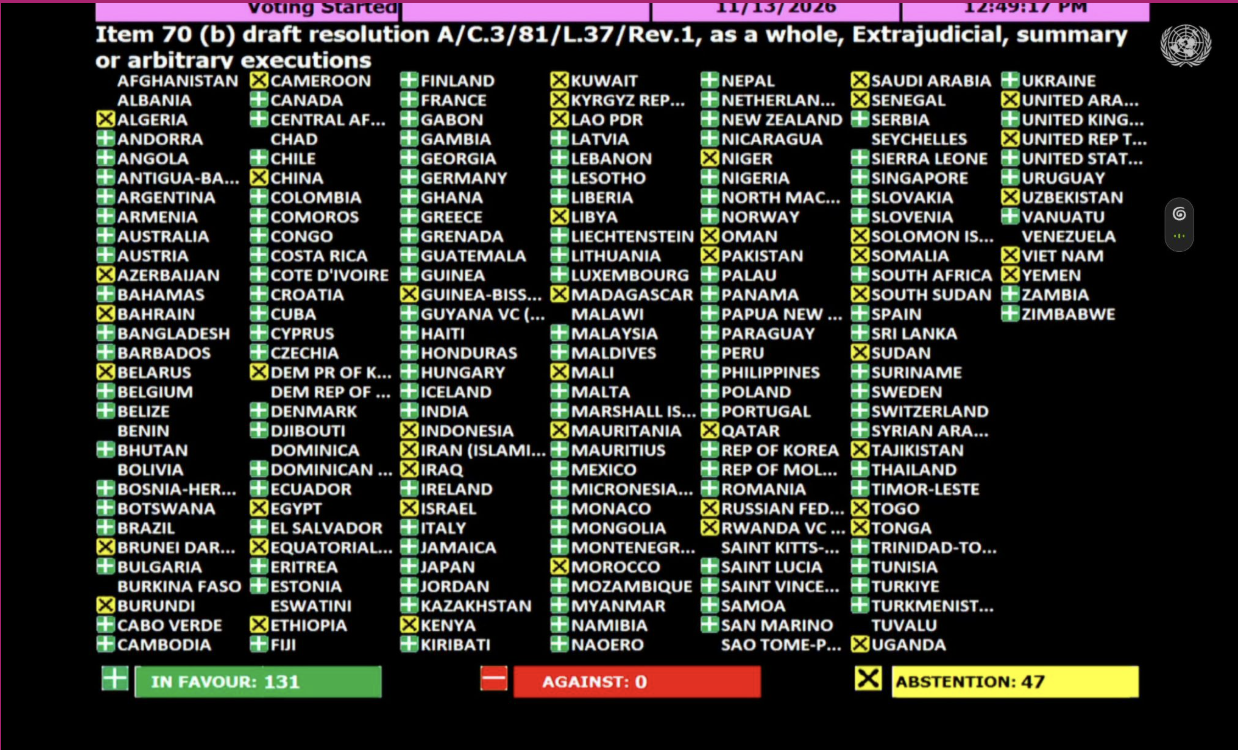
Caption: Voting chart for the resolution as a whole.
Holding the line: Finland and its Nordic partners – Denmark, Iceland, Norway and Sweden – led the introduction of the resolution and the defence of the language. Strong interventions in support were made by Australia, Brazil, Canada, the European Union, Mexico and Uruguay, to name a few.
Civil Society: On November 10, Outright, Amnesty International, Human Rights Watch, ILGA World and the International Service for Human Rights wrote to all 193 UN missions urging them to defend the resolution’s full list of targeted groups. The letter was co-signed by 127 organizations and 2,149 individuals from 112 Member States. “Removing just one category,” the letter warned, “puts every other category at risk on the same terms.”
Outright urges all Member States to stand by the resolution as adopted today, with its full list of victim groups intact, when it comes again before the General Assembly in December.
Read Our Publications
Since 1990, we have partnered with activists from all over the world to produce hundreds of groundbreaking reports.
Learn More