blog page block - Blog Page Block
“&PROUD” Myanmar’s First-ever LGBT Film Festival
November 12, 2014| Contributed by Ging Cristobal, Project Coordinator for Asia, IGLHRC
November 14-16, Colors Rainbow, Abadi Art, Theik Khar Myanmar and various artists and activists will present the first "&PROUD" Yangon LGBT Film Festival, featuring 33 long and short films and documentaries from around the Asia region, including seven films produced in Myanmar. The films will showcase issues and challenges faced by LGBT people in Southeast Asia and other Asian countries
An Unprecedented Advance for Trans Rights in Malaysia
November 7, 2014| Contributed by IGLHRC
"Today's ruling sets a critical precedent for recognizing and affirming the human rights—and lives—of trans women in Malaysia," said Grace Poore, regional program coordinator for Asia at IGLHRC. "Long the subject of state-sanctioned violence and persecution, trans Malaysians now have a ruling that recognizes the federal constitution supersedes local laws, particularly when these laws blatantly contravene the protections enshrined in the constitution."
Listen: Hossein Alizadeh Discusses LGBT Rights in Iran on BBC Newshour
November 3, 2014| Contributed by IGLHRC
On Sunday, Hossein Alizadeh, Regional Program Coordinator for MENA was on BBC Newshour to discuss rights violations against LGBT people in Iran, particularly common social misconceptions about sexual orientation and gender identity and how some individuals report being coerced by the society—including their immediate family members—to undergo sex reassignment surgery to 'normalize' their sexuality and to avoid criminalization.
Fostering Collaboration Globally on LGBTI Rights
October 31, 2014| Contributed by Cole Delbyck, Communications Intern, IGLHRC
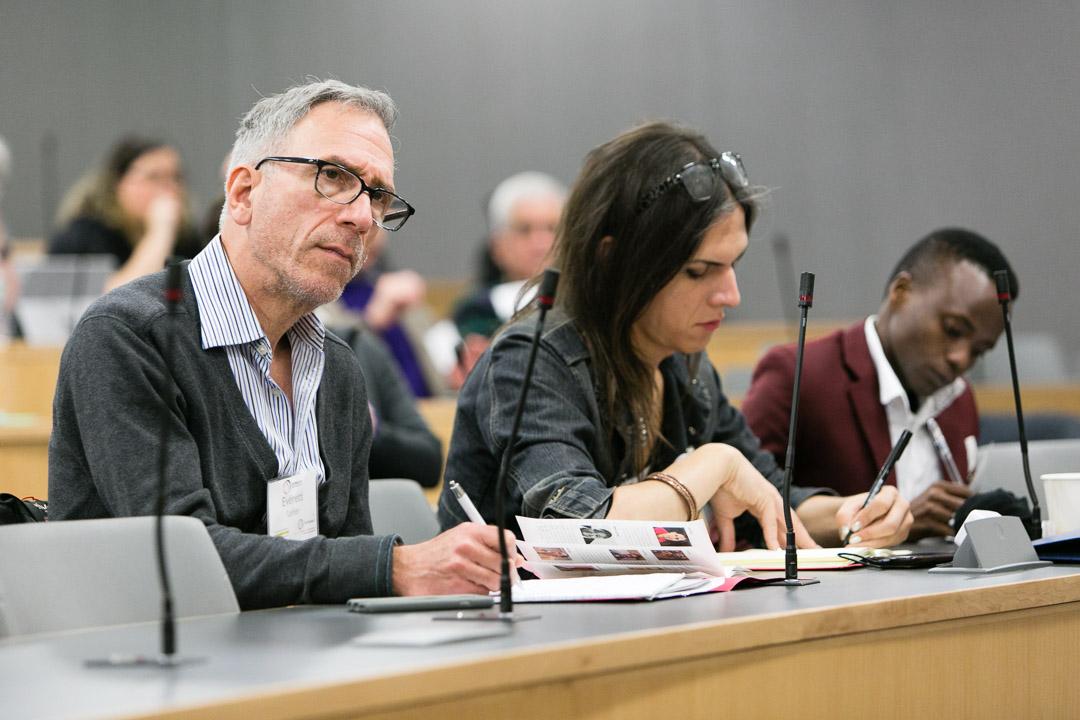
The International Gay and Lesbian Human Rights Commission hosted African LGBTI activists Chesterfield Samba of Zimbabwe and Dorothy Aken’ova of Nigeria on Wednesday, Oct. 29 for a conversation aimed at increasing collaboration between the continent’s activists and advocates around the world.
Speaking Out About Violence Against Trans People
October 30, 2014| Contributed by IGLHRC
Marianne Møllmann, IGLHRC’s director of programs, Andrés Rivera Duarte, a consultant to IGLHRC on transgender rights in Latin America and to the Chilean National Observatory for Human Rights and Law, and Wilson Castañeda of the Colombian group Caribe Afirmativo spoke out against the widespread and systematic violations of human rights against the transgender population of Latin America, especially discrimination and violence, at a hearing held by the Inter-American Commission on Human Rights.
#JusticeForJennifer: Filipino Communities Organize National Day of Outrage Friday, October 24 in Response to Killing of Jennifer Laude
October 23, 2014| Contributed by Ging Cristobal, Project Coordinator for Asia, IGLHRC
In the Philippines, the killing of a transgender woman, Jennifer Laude, has ignited calls for justice. Her death became a breaking point for activists who have been pushing for government action to address gender-based violence against women and the LGBT community.
Jamaican Activist Reflects on Second Caribbean Women and Sexual Diversity Conference
October 15, 2014| Contributed by Paige Andrew, Programme Team, J-FLAG (Jamaica Forum for Lesbians All Sexuals and Gays)
The second Caribbean Women and Sexual Diversity Conference with the theme “Inspiring Women to leadership” was convened in Suriname October 5 to 12 by United and Strong St. Lucia with support from CariFLAGS, WomenSWaySuriname and international partners. IGLHRC’s Jessica Stern and María Mercedes Gómez participated in the conference and facilitated a capacity-strengthening workshop for human rights documentation. Paige Andrew of J-FLAG shares her experience and the impact the conference will have on her advocacy in the following post. Empowering and extremely fulfilling; those are the words that come to mind, when I think of my experience at the second Caribbean Women and Sexual Diversity Conference (CWSDC), which was held in Suriname in October this year. As a queer person and budding activist, the conference was an incredible experience. The workshops were not only informative and engaging, but exciting. The practical aspect of the workshops, made it easy for the participants to gauge exactly how we would use the information, in our fight for LGBT equality in the Caribbean.
There is a Voice that is Silent from Africa
December 27, 2013| Contributed by Leigh Ann van der Merwe, Director, S.H.E.
There is a voice that is silent from Africa… a voice no one hears, despite its loud scream. There is a faceless person, despite standing in a crowd of millions. That person has a name, a face, and an identity. These are the transgender women in South Africa. Strides have been made for the rights of transgender people in South Africa, yet many of the issues affecting black, impoverished transgender women go unattended. This is where the idea of a feminist collective dedicated to addressing the issues of transgender women in South Africa originated and S.H.E. (Social, Health and Empowerment feminist collective of transgender and intersex women of Africa) was established.
Transgender Women’s Constitutional Challenge To Sharia Law Fails in Malaysia
October 15, 2012| Contributed by Grace Poore, Regional Program Coordinator for Asia, IGLHRC
Many countries in the Southeast Asian region are incrementally shifting on lesbian, gay, bisexual and transgender (LGBT) people’s rights:
Vietnam’s Minster of Justice said publicly that rights of same-sex married couples should be recognized. The Philippines Supreme Court has ruled that an LGBT party had the right to participate in national elections. A Singapore Appeals Court ruled that the constitutionality of Section 377A of its Penal Code needs to be examined because it discriminates against gay men. Thailand has long been known as the place to go for gender reassignment surgery. Indonesia’ s Parliament will soon decide whether to appoint the first openly gay man as commissioner on its National Human Rights Commission.The Malaysian government however continues to stubbornly reject the rights of LGBT people. This position reverberates throughout state institutions, encouraging hostility, discrimination, and abuse by state and religious authorities.
Paradojas Chilenas: Derechos LGBT en América Latina
August 15, 2012| Contributed by Pedro Garcia, 2012 Paula Ettelbrick Fellow, IGLHRC
To read the original article in English, visit: Chilean Paradoxes: LGBT rights in Latin America
Durante los últimos años ha habido avances importantes en materia de derechos humanos para la población gay, lesbiana, bisexual y transexual (LGBT) de América Latina. El reconocimiento de uniones civiles para parejas del mismo sexo en Brasil y en Uruguay, matrimonio homosexual en la Ciudad de México y en Argentina, y leyes que protegen la identidad de género en Bolivia, Chile y Argentina. Estos cambios ponen en duda viejos estereotipos que califican al subcontinente como una región conservadora, machista, y dominada por la moral de la iglesia católica.
La lucha por los derechos humanos LGBT en América Latina no es un camino de un solo sentido. Existen paradojas dentro de los Estados y entre las naciones. El año en que la Ciudad de México legalizó el matrimonio para parejas del mismo sexo, únicamente el 29% de la población de la ciudad apoyaba el derecho de estas parejas a adoptar. En Ecuador, la Constitución prohíbe explícitamente la discriminación por motivos de orientación sexual, pero también rechaza textualmente el matrimonio y la adopción por parejas del mismo sexo. EL matrimonio gay es legal en algunos casos en Brasil, pero la población transgénero sigue siendo víctima sistemática de violentos crímenes de odio. En el 2009, Brasil reportó el mayor número de asesinatos a personas transgénero del continente. En Costa Rica el diputado evangélico Justo Orozco, quien ha afirmado que la orientación sexual es un pecado y debe tratarse, es también presidente de la Comisión de Derechos Humanos.
Chilean Paradoxes: LGBT rights in Latin America
August 13, 2012| Contributed by Pedro Garcia, 2012 Paula Ettelbrick Fellow, IGLHRC
Para leer este artículo en español, mira: Paradojas Chilenas: Derechos LGBT en América Latina
Over the past few years, there have been important milestones advancing LGBT human rights in Latin America. Recognition of civil unions in Brazil and Uruguay, same-sex marriage in Mexico City and Argentina, laws protecting gender identity in Chile and Bolivia, and historic, progressive legislation in regard to gender identity in Argentina. These advances question old stereotypes of the region as a conservative macho culture dominated by the morals of the Roman Catholic Church.
The fight for LGBT human rights in Latin America isn’t a one-way street. Paradoxes arise among and between countries. When Mexico City legalized same-sex marriage by legislative action, only 29% of the city’s population supported the right to adoption by same sex partners. In Ecuador, the Constitution prohibits discrimination based on sexual orientation yet bans same-sex marriage and adoption. Gay marriage is legal on a case-by-case basis in Brazil but transgender people continue to be the target of violent crime. In 2009, Brazil reported the highest number of murders of transgender people for the region. In Costa Rica, the president of the Legislative Assembly’s Human Rights Commission expressed his belief that sexual orientation is a sin that can be treated. Clearly, homophobia and transphobia are widespread in the region.
Indonesian Government Questioned About LBT Rights Violations
July 13, 2012| Contributed by Grace Poore, Regional Program Coordinator for Asia, IGLHRC
Women’s human rights defenders from Indonesia arrived in New York this week to report to the Committee for the Elimination of Discrimination Against Women (CEDAW) about flagrant violations experienced by women and girls in Indonesia across all sectors of society – female circumcision, unsafe abortions, forced sterilization of minority women, marital rape, polygamy, weak implementation of the domestic violence law, police abuses, abuses by domestic worker recruitment agencies, failure to grant reparations to women sexually violated during conflicts with the Indonesian military and police forces, judicial disregard for violence and discrimination against women, rampant abuses against women migrant workers, and many more.
Yet, violence and discrimination against lesbians, bisexual women and transgender (LBT) women was not on the agenda. The spread of intolerance by religious fundamentalists had driven a wedge within the Indonesian women’s movement. Except for one 145-page shadow report that mentioned sexual orientation and gender identity (SOGI) once, LBT people were invisible. Even Komnas Perempuan, the National Commission of Women was reluctant to raise LBT issues. As one Commissioner explained, “The fundamentalists are saying that when we push for women’s rights we are pushing for same sex marriage. So if we bring up LBT, it will weaken our advocacy.” Another Commissioner assured me, “We can raise the LBT issue at the next CEDAW session.” But that would be five years down the road!
End Sexual-Orientation and Gender-Identity Discrimination in Guyana
July 11, 2012| Contributed by
The Committee on the Elimination of Discrimination against Women ("CEDAW Committee"), meeting this month at United Nations headquarters in New York City, will review the human-rights record of several countries that are signatory parties to the Convention on the Elimination of All Forms of Discrimination against Women (CEDAW). In recent years the CEDAW Committee has increasingly included the rights of lesbian, bisexual, and transgender (LBT) women in its deliberations. During the week of July 9, Guyana will be reviewed. There has been strong engagement by LBT activists in preparation for the hearing. In the case of Guyana, an LBT-specific shadow report, "Human Rights Violations of Lesbian, Bisexual, and Transgender (LBT) People in Guyana," was jointly drafted and submitted by three human-rights organizations: Guyana RainBow Foundation (GuyBow), the International Gay and Lesbian Human Rights Commission (IGLHRC), and the Society Against Sexual Orientation Discrimination (SASOD). I had the privilege of making an oral presentation of this report to the members of the CEDAW committee on July 9 at the UN.
Celebrating Pride... Beyond the White House
June 15, 2012| Contributed by Jessica Stern, Executive Director and Peter Dunne, Former Harvard Law School Irving R. Kaufman Public Interest Fellow, IGLHRC
On June 15, as U.S. President Barack Obama hosted a reception at the White House to mark Pride Month, the now annual celebration of lesbian, gay, bisexual, and transgender (LGBT) lives across the United States, there was much to contemplate about U.S. foreign policy and LGBT human rights.
While many celebrated advances made in the U.S. over the past year, this annual White House reception is an opportunity to recognize the efforts the Obama administration has made to promote LGBT human rights beyond U.S. borders. In December 2010 U.S. Ambassador to the United Nations Susan Rice spearheaded efforts to ensure that sexual orientation would remain part of a resolution condemning extrajudicial killings. Last December Secretary of State Hillary Clinton spoke movingly at the United Nations Human Rights Council in Geneva of how "gay rights are human rights and human rights are gay rights." And President Obama the same day issued an executive memorandum calling upon U.S. diplomats to make LGBT human rights a priority in American foreign policy.
We’re Going to the White House and We Want to Bring You with Us!
June 11, 2012| Contributed by Brian Tofte-Schumacher, Digital Communications Manager, OutRight Action International
OutRight Action International, for the first time, has been invited to the White House LGBT Pride Reception, but we don’t want to go alone! Jessica Stern, Acting Executive Director, will attend the reception and she wants to bring your perspectives, opinions, critiques and stories with her. For the next five days, we’ll be asking you questions on facebook (fb.com/iglhrc) and twitter (@iglhrc) such as: If you could tell President Obama one way he could help you work for LGBT rights globally, what would you say?