blog page block - Blog Page Block
Yesterday's Vigils for David Kato in New York and Cape Town
February 4, 2011| Contributed by
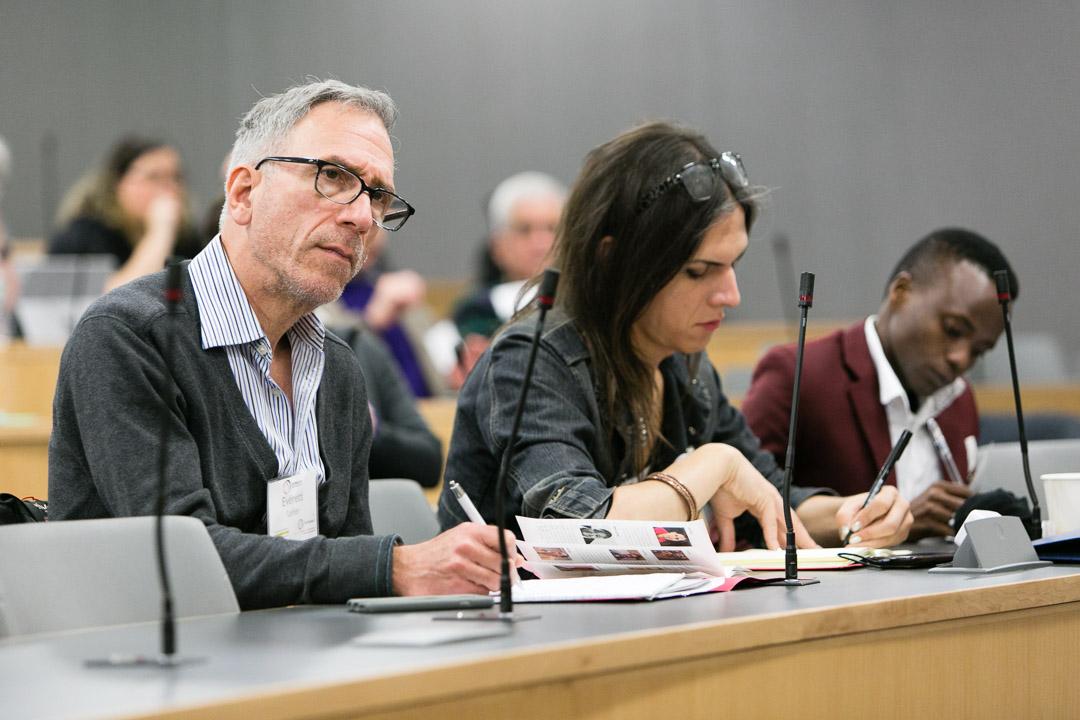
IGLHRC would like to thank everyone who came out to the vigil and procession to honor slain Ugandan activist David Kato yesterday in New York. We estimate the crowd was over 200 people in New York. On an icy February night, that says a lot about how much David's death has impacted us all. The speakers included Amanda Lugg, Rev. Pat Bumgardner, Cary Alan Johnson, Val Kalende, Daniel Dromm,Christine Quinn, Cheikh Traore, Rev. Kapya Kaoma, and Pastor Joseph Tolton. Note, part of Val's presentation included text from the blog SpectraSpeaks.
We would also like to thank all the cosponsoring organizations, of which there were over 40, and the inspiring and courageous speakers who brought context and meaning to this critical moment and gave voice to the LGBT movement's grief and anger in the wake of David's death. In particular, IGLHRC would like to thank Val Kalende, of Freedom and Roam Uganda, for traveling to NYC at this difficult time, for so powerfully naming this tragedy, and for helping to guide us in our grief and activism. As Val said, "David belongs to all of us now."
Ugandan LGBT Rights Defender, David Kato
January 28, 2011| Contributed by OutRight Action International
OutRight Action International stands in solidarity with Uganda’s lesbian, gay, bisexual and transgender (LGBT) community in strongly condemning yesterday’s killing of human rights defender David Kato. OutRight Action International joins groups across the world to demand that the Ugandan government immediately denounce David’s murder, thoroughly and impartially investigate this heinous crime and ensure the safety of all LGBT Ugandans.
International Day to End Violence Against Sex Workers
December 17, 2010| Contributed by IGLHRC
December 17th marks the 7th annual International Day to End Violence Against Sex Workers. On this day, the International Gay and Lesbian Human Rights Commission (IGLHRC) stands in solidarity with sex workers around the world and calls on governments to remove the conditions that engender violence against sex workers, including criminalization of sex work. IGLHRC also stands with transgender sex workers, who face the compounded violence and discrimination as sex workers and as transgender people.
In an unpublished report, the UN Independent Expert on Human Rights and Extreme Poverty has identified how poverty and gender identity-based discrimination are intricately linked for transgender people, “[T]he extreme poverty many trans people…confront is a direct cause and consequence of the constant discrimination they suffer merely because of their trans identity and expression. Such discrimination not only quickly pushes them to poverty, but also deepens it, perpetuating discriminatory attitudes and practices against them.” Moreover, studies have found that poverty, undocumented immigration status, and discrimination on the basis of gender identity and expression are central reasons why transgender people enter sex work to begin with.
Transgender Day of Remembrance 2010
November 24, 2010| Contributed by IGLHRC
November 20th, 2010 marked the 12th annual Transgender Day of Remembrance. On this day we remember those who have been killed by hatred and prejudice against transgender people and raise public awareness to combat violence against transgender people.
On Transgender Day of Remembrance, IGLHRC also celebrates the tremendous work of transgender activists and human rights defenders committed to promoting and protecting the human rights of transgender people. This is a powerful opportunity to insist that transgender rights are human rights, and that all members of the global community have an obligation to stop violence against transgender people.
Reflections of a Thai TransGender Activist on the Transgender Day of Remembrance
November 24, 2010| Contributed by Sitthiphan (HUA) Boonyapisomparn, Thai TransGender Activist
“What is Transgender Day of Remembrance?” I asked myself when I heard about this day for the first time. I had never heard of Transgender Day of Remembrance before and had never experienced why the day is so special and important to transgender people. I would be unable to answer if people asked me to share what we have done on this day in my country. Honestly, I might have even thought that Transgender Day of Remembrance isn’t important to an activism and the transgender movement in Asia, but I see now this isn’t the case.
As a transgender person, I always feel insecure when I travel to somewhere I am not familiar. Since I was born, people often brought me down intentionally or unintentionally for being transgender. I feel like we, transgender people, have the same feelings of fear and sometimes we bring those fears to ourselves. Fear of being transgender or of being yourself, known as transphobia, is internalized, which affects the way you see yourself. “It’s wrong and uncommon to be transgender” I thought when I was young.
Constitutional Reform in Zambia: Managing the Impact
November 11, 2010| Contributed by Chivuli Ukwimi, Former Health and Human Rights Officer, IGLHRC
Despite its relatively young existence Zambia has attempted four times to amend her constitution. For the Zambian LGBT community the most recent efforts to make a credible, durable and legitimate constitution, have in fact dealt the community a severe blow. The National Constitutional Conference (NCC) – the official body tasked with driving the reform process and rewriting the constitution – recently included a clause that forbids marriage between people of the same sex in the draft constitution. Friends of Rainka, an LGBT organization in Zambia condemned the move by the NCC as a direct attack on an already vulnerable community – and one that may overshadow any successes that the community has made to date. This condemnation is only one step in the response of activists to this threat to the human rights of LGBT people in Zambia.
To increase awareness and understanding of the constitution making process and to strengthen the capacity of activists to respond to its outcomes and implications for LGBT rights in Zambia, 12 Zambian LGBT activists and 4 allies attended a training on Constitutional Reform in Zambia: Managing the Impact from October 28-29, 2010 in Lusaka Zambia.
Mongolian LGBT Activists at the Human Rights Council
November 10, 2010| Contributed by Otgonbaatar (Otgo) Tsedendemberel, Lesbian, Gay, Bisexual and Transgender Centre
My name is Otgoo (Otgonbaatar Tsedendemberel) and I am a gay rights activist from Mongolia. This blog entry shares my experiences during a recent trip to the United Nations in Geneva to advocate at the Human Rights Council on behalf of my organization, the Lesbian, Gay, Bisexual and Transgender Centre based in Ulaanbaatar, Mongolia.
It took about three years to get our organization officially registered by the Mongolian authorities. Basically, the government argued that the name “Lesbian, Gay, Bisexual and Transgender Centre” has a meaning that conflicts with Mongolian customs and traditions and has the potential to set a wrong example for youth and adolescents. Eventually, we were officially registered and handed our certificate in December 2009. We are now the first-ever Mongolian NGO mandated to uphold, protect and ensure the human rights of sexuality minorities. One of the highlights of our work since our official existence is that we submitted a sexuality minorities’ report as well as a lesbian, gay, bisexual and transgender (LGBT) rights report together with Sexual Rights Initiative (SRI) to the Universal Periodic Review (UPR) of Mongolia in the Human Rights Council. I came to Geneva to do advocacy activities relating to both the UPR process as well as the Committee Against Torture, to attend the UPR 9th Session and, most important of all, to make sure the often suppressed voices of the Mongolian LGBT community heard at the United Nations.
Victory at the Human Rights Council
November 10, 2010| Contributed by Otgonbaatar (Otgo) Tsedendemberel, Lesbian, Gay, Bisexual and Transgender Centre
The review of Mongolia started with the opening remarks by Mr. Rodolfo Reyes Rodriguez, Vice President of the Human Rights Council (HRC). Then His Excellency Mr. Tsogtbaatar Damdin, State Secretary of Ministry of Foreign Affairs and Trade (MFAT) of Mongolia introduced Mongolian government officials and delegates (consisting of seven men and two women from Mongolian Ministries, National Human Rights Commission, and General Police Department). He then introduced the human rights situations of Mongolia in general terms, highlighting some issues such as capital punishment, desertification and other natural disasters, and people with disabilities.
After that, the most exciting part of the review commenced with each State asking questions and making recommendations. There were 43 States listed to speak for two minutes each. The first eight countries spoke with no mention of the LGBT rights issues and I started to feel nervous. Then, Canada stated, “Canada recommends that the Government of Mongolia (GoM) enacts broad-based anti-discrimination law that specifically protects … based on sexual orientation and gender equality.” A breath of relief! This was the mission delegation I met only the night before the review to insist that they include our LGBT rights issues. At this point, I realized the effectiveness of lobbying and advocacy activities done in advance of the review.
Part One: “Why CEDAW?” and Crafting an Inclusive Shadow Report
November 2, 2010| Contributed by IGLHRC
One hundred and eighty six States, including Uganda which signed the CEDAW Convention in 1980, have committed to implementing this international human rights treaty that is sometimes described as a “bill of rights for women.” These states are required to submit regular reports on how they are implementing the rights in the CEDAW Convention to the CEDAW Committee - the committee made up of independent human rights experts from different countries monitors compliance, addresses concerns and offer recommendations to governments. Civil society also has the opportunity to inform the committee on how they see the human rights situation in their country in the form of ‘shadow’ or ‘alternative’ reports.
Given that CEDAW is referred to as a “bill of rights for women” how then is this relevant to discrimination based on sexual orientation and gender identity? Kasha N. Jacqueline, the Executive Director of Freedom and Roam Uganda (FARUG), an organization that fights for the rights of lesbian, bisexual and transgender people in Uganda, explains, what the CEDAW Convention means to her organization and why they decided to submit a report to the CEDAW Committee:
Part Two: Advocacy in Geneva and the CEDAW Committee’s Recommendations
November 2, 2010| Contributed by Sara Perle, Former Ric Weiland Research & Policy Associate, IGLHRC
The second week of October 2010 saw the meeting of the CEDAW Committee in Geneva to consider the reports of various countries - including that of Uganda. Kasha N. Jacqueline, the Executive Director of Freedom and Roam Uganda (FARUG), an organization that fights for the rights of lesbian, bisexual and transgender people in Uganda, attended that session along with an IGLHRC staff person, human rights activists from Uganda, Malta, and the Czech Republic, and several staff of the Malaysian NGO, International Women's Rights Action Watch Asia Pacific. These activists had the opportunity to engage in an interactive dialogue with the CEDAW Committee, presenting the key issues of their shadow reports and answering further questions the Committee had about their States’ human rights records.
Kasha spoke of the many violations and recommendations included in the FARUG shadow report, particularly noting the explicit exclusion of sexual minorities from the Ugandan Equal Opportunities Commission. However, she also brought to the Committee’s attention violations that had occurred only days before--when a Ugandan tabloid, “Rolling Stone,” printed a list of the names, pictures, and contact information of “known homosexuals,” including members of FARUG, with the headline “Hang Them.” As a result of that publication one of FARUG’s members, who had also contributed to the CEDAW shadow report, had been attacked at her house and on the street with stones being thrown at her.
Moroccan Queers Observe National LGBT Day
October 27, 2010| Contributed by Karim Al-Samiti, Member, Kifkif
The following is a report on the observance of national LGBT day in Morocco, written by Karim Al-Samiti, an active member of the Moroccan LGBT group Kifkif and one of its founders. Karim is also on the editorial board of Mithly, a Moroccan LGBT monthly publication in Arabic and French (http://www.mithly.net/). The Arabic version of this report is posted on Kifkif’s website (http://www.gaymaroc.net/ar/national/5140--19-). As part of our ongoing effort to promote the work of our partners, IGLHRC presents an English translation of the report.
On October 23, 2010, LGBT Moroccans held a ceremony in the capital city, Rabat, to observe Moroccan national LGBT day, which is usually celebrated on October 19. This year’s ceremony was attended by Kifkif members from across the Kingdom, and several members of the group from overseas. The ceremony continued throughout Saturday evening and was packed with various activities. The highlight of the event was a panel discussion, open to all participants, to discuss problems and challenges individuals face because of their sexual orientation, which prevents them from living in peace and safety, free from fear of symbolic or actual violence. All participants also expressed hope that the government of Morocco would allow the Kifkif group to work on the ground, given that the group represents an important segment of the Moroccan population.
SOGI Takes Center Stage At Asia Pacific Forum of National Human Rights Institutions – Part 1
September 10, 2010| Contributed by Grace Poore, Regional Program Coordinator for Asia, IGLHRC
Lesbians, gays, bisexuals and transgender (LGBT) people in Asia and the Pacific Islands experience extra-judicial killings, torture, violence and rape, as well as discrimination in employment, education, housing and health services. These are the preliminary findings of the Advisory Council of Jurists (ACJ) of the Asia Pacific Forum of National Human Rights Institutions (APF) that met August 3-5, 2010 in Bali, Indonesia. This independent body of legal experts has found that at least 17 API governments1 have failed to provide protections for LGBT people because their national laws, policies and practices are inconsistent with international human rights law.
In response to these realities for LGBT people in the region, the APF has begun the process of addressing discrimination and violence on the basis of sexual orientation and gender identity as a legitimate human rights issue requiring the attention of its member institutions that are National Human Rights Institutions (NHRIs). The fact that protecting the human rights of LGBT people has captured the attention and become a focus for the APF is pleasantly surprising. Surprising because, only three countries in the region have laws providing explicit protection of LGBT human rights2, while nineteen countries still have laws that criminalize consensual homosexual relations3. Many of the NHRIs that are members of the APF have never discussed – let alone considered – sexual orientation and gender identity as a human-rights issue. In fact, many state officials in the region view non-heteronormative sexual orientation and gender identity as anti-religious and counter cultural.
SOGI Takes Center Stage At Asia Pacific Forum of National Human Rights Institutions – Part 2
September 10, 2010| Contributed by Grace Poore, Regional Program Coordinator for Asia, OutRight Action International
The findings and recommendations of the Advisory Council of Jurists presented to the Asia Pacific Forum of National Human Rights Institutions (APF) during its August 2010 meeting in Bali, Indonesia were significant. As I shared in the first part of this review, it was a major achievement for this independent body of legal experts to conclude that at least 17 API governments have failed to provide protections for LGBT people because their national laws, policies and practices are inconsistent with international human rights law. In response the ACJ is recommending that national human rights institutions take on issues of sexual orientation and gender identity and ensure the compliance of national laws and policies with international human rights protections for LGBT people in a way that involves the participation of LGBT groups and individuals. For me, so much rides on the NHRIs effectively implementing the ACJ recommendations since the API region lacks a regional human rights monitoring entity (even the credibility of the newly-formed ASEAN Commission on Human Rights (ACHR) is uncertain). In addition, access to international human rights entities such as the United Nations is limited, not only because the UN is so far away, but also because people whose rights are being violated, have limited access to these avenues for redress – assuming redress is possible.
Una reflexión sobre la institución de matrimonio
July 22, 2010| Contributed by Rosa M. Posa Guinea, Former Project Consultant for LAC Institute, IGLHRC
Desde que se aprobó el matrimonio entre personas del mismo sexo en Argentina, se han despertado dos debates: uno interesante y el otro no sé si es un debate.El debate interesante es el cuestionamiento del matrimonio como institución, como forma de vida e incluso iría más allá, cuestionar la misma pareja como único modo de relación amorosa, sexual. Respecto al matrimonio en sí, hay muchas cosas que decir ¿no ha sido durante siglos la forma de opresión más brutal, silenciosa y cotidiana para miles de mujeres, es decir, su esclavitud?; (esto ya lo decía Serafina Dávalos en 1907, ella fue la primera abogada y feminista del Paraguay, que, por cierto, nunca se casó y vivía con su “compañera inseparable” ). Me dirán que se trata del matrimonio heterosexual, sí… pero realmente podemos re-significar la institución?
Además, ¿no nos siguen vendiendo a todo el mundo el mito de amor eterno y del matrimonio como la forma de consolidarlo? O sea, el amor “verdadero” dura toda la vida y parece que queda más fijo si el Estado lo reconoce, (para alguna gente todavía más si es que dios lo bendice) por eso es tan difícil salir en casos de violencia doméstica, porque el mito del amor eterno-matrimonio no se cuestiona, no se mueve. No pensamos que es un mito, sino que pensamos que es algo que no alcanzamos porque fallamos en algo. Hay mucho que hablar sobre esto… ¿De verdad el matrimonio es la forma en la que queremos encasillarnos?; ¿No se trata de una estructura opresiva?; ¿Para que luchar para obtener la misma opresión que caracterizó a la heterosexualidad obligatoria?
Same-Sex Marriage in Argentina - A Reflection on the Institution of Marriage
July 22, 2010| Contributed by Rosa M. Posa Guinea, Former Project Consultant for LAC Institute, IGLHRC
Since the legalization of same-sex marriage in Argentina, two different debates have emerged: one is interesting and it is unclear whether the other is a debate at all. The interesting debate is the question of marriage as an institution, as a way of life; even further, it is the question of partnership itself as the only way of experiencing love or sexual relations. With respect to marriage itself, there are many things to discuss. For centuries, has it not been the most brutal, silent, and everyday form of oppression for thousands of women—one might even say, their enslavement? Paraguay’s first feminist lawyer, Serafina Dávalos – who, incidentally, never married and lived with her “inseparable companion” – already made this argument in 1907.1 I will be told, of course, that she spoke with regards to heterosexual marriage - but can we really re-signify the institution?
On the other hand, don’t we go on selling the myth of eternal love, and marriage as the method of consolidating it, to the entire world? In other words, "true" love is life-long and it is perceived as more stable if the state recognizes it, and for some, even more so if God blesses it. That is why it is so difficult to escape in cases of domestic violence, because the myth of eternal love and marriage is never questioned, it is never challenged. We do not think it is a myth; rather, we think it is something that we personally cannot attain because we have failed at something.